
You are a “hazmat employee”
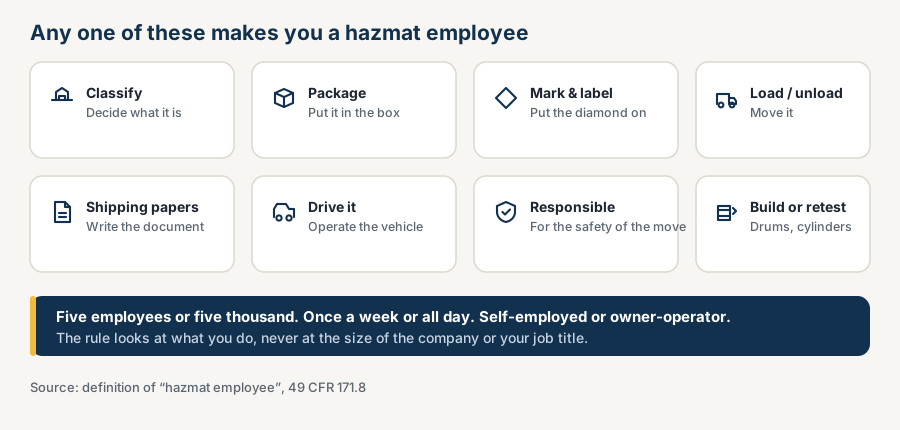
If your job touches hazardous materials in any way — you classify them, package them, mark or label them, load or unload them, prepare shipping papers, operate a vehicle carrying them, or you are responsible for the safety of transporting them — federal law calls you a hazmat employee. It also includes anyone who manufactures, reconditions, repairs, inspects or tests a package represented as qualified for hazardous materials: the person who rebuilds drums or retests cylinders is a hazmat employee too. It does not matter whether the company has five people or five thousand, and a self-employed person or owner-operator is covered exactly the same. It does not matter whether you do it once a week or all day.
The rules are the Hazardous Materials Regulations, published in Title 49 of the Code of Federal Regulations (49 CFR). The training rule is 49 CFR 172.704, and it says two things that matter to you today: you must be trained before you perform hazmat functions unsupervised, and you must be trained again at least every three years.
This is where the fragment ends. Module 1 continues with what happens without training and how the course works, and the other six follow after it.
A sample question
The course ends with a 20-question assessment. You need 80% to pass, and retakes are free and unlimited. The question below was written for this preview using the material you just read — it is not one of the twenty, so reading it does not give away any part of the assessment.
- Yes. Reconditioning a package represented as qualified for hazardous materials is itself a hazmat function.
- No, because the shop never offers or transports a hazardous material.
- No, because the drums are empty when they leave.
- Only if the shop also prepares the shipping papers.
Show the answer
Ready when you are
The full course is seven modules, in English or Spanish, at your own pace. Estimated completion time: approximately 1 hour. Self-paced; actual time varies. When you pass you download two documents: the certificate and the 49 CFR 172.704(d) training record your employer keeps.
Start Training — $49 Back to the course page
Training a team? View team plans — 5 seats $220, 10 seats $390.
Independent training provider — not affiliated with DOT or PHMSA. What that means.